
SketchUp 2026.0
26.0.429 Win 64 位元
26.0.428 Mac 64 位元
SketchUp 2026.0 有哪些新功能?
Desktop 版 SketchUp
在 SketchUp 協同合作 – 您現在可以透過私人邀請,或建立並分享公開連結來分享 SketchUp 模型。被分享者可以瀏覽模型、進行測量、留言評論,甚至能即時看到更新內容。
視覺化 – SketchUp 26.0 新增環境光遮蔽的距離倍增器與顏色控制、可反轉材質粗糙度貼圖,以及材質縮圖自選等備受期待的功能。
效能 – SketchUp 2026.0 全面提升記憶體管理與運作效率,讓 SketchUp 更高效、更快速、更穩定。這些效能更新在處理大型模型時效果尤為顯著。
動態元件 – SketchUp 2026.0 為比例工具新增了掣點功能 (
 ),讓您能依據推算,輕鬆定位並調整動態元件的尺寸。現在您也能利用油漆桶工具 (
  ),將材質套用至元件預設選項外的部位,因此我們針對繪製動態元件新增了多項使用者體驗改進。
建模流程與介面更新 – SketchUp 2026.0 在縮放、旋轉、場景及推算等功能上都有多項顯著改善。
管理授權啟用 – 您現在可直接在 Desktop 版 SketchUp 內重設所有授權啟用,並授權目前的裝置。
互通性 – SketchUp 2026.0 現在針對匯入與匯出 DWG 檔案,在保真度及效率上帶來多項升級。這些提升包括支援填充圖案,同時保留剖面平面。IFC 匯出流程亦已升級,將 IFC 2x3 與 IFC 4 統整為單一檔案類型,並擴展了匯出選項。
Scan Essentials – Scan Essentials 新增兩種點雲建模流程:材質投影與網格生成工具。此全新場景管理器能充分控制點雲於 SketchUp 與 LayOut 中的可見性。這次更新還讓您在匯出時,可輕鬆回復至原始的地理參考座標系統。
LayOut
LayOut 介面與效能更新 – Windows 版 LayOut 介面外觀與操作更貼近 SketchUp,且圖示風格、工具盤和面板設定,以及工具列自訂等皆已更新。
LayOut 製圖工具 – 現已推出四項全新製圖工具:修剪、延伸、圓角與倒角。讓您以更直覺、更高效的方式建立與操控 2D 向量繪圖。
剪貼簿增強 – LayOut 預設剪貼簿現於「建築」分類下新增 2D 窗戶、門、家具、廚房、衛浴圖庫,另外也新增了平面圖人物元件庫。
匯入與匯出增強 – LayOut 2026.0 針對 DWG 功能進行多項更新,全面強化 LayOut 匯入與匯出 DWG 文件的效率,包括保留 SketchUp 標籤並自動轉換成 DWG 圖層。
錯誤修復和其他功能改進
SketchUp
在 SketchUp 協同合作
我們做了什麼
您現在可以透過私人邀請,或建立並分享公開連結來分享 SketchUp 模型。被分享者可以瀏覽模型、進行測量、留言評論,甚至能即時看到更新內容。
詳細資料
SketchUp 2026.0 推出多項新功能來協助您分享模型,並與同儕、利害相關人協同合作。這些功能都整合在全新的協作工具列中,可協助您分享模型、控管分享對象的存取權限,並邀請他人提供回饋意見。
使用協作工具列進行分享
協作工具列 (  ) 在 SketchUp 的預設工具列與大型工具組中都能找到。您也可以點選 「Window > Collaboration Bar(視窗 > 協作工具列)」 開啟。
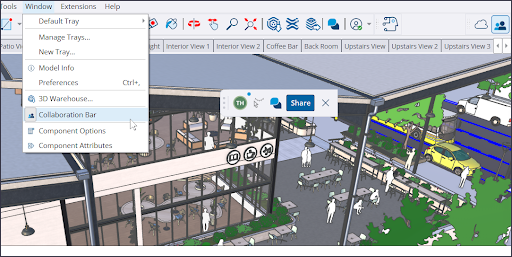
在協作工具列中,點選 「Share(分享)」 即可邀請他人檢視您的模型。若尚未將模型儲存至 Trimble Connect,系統會跳出提示,請您先儲存。
欲傳送私人邀請時,請輸入電子郵件地址並設定其存取權限。檢視者將收到帶有私人連結的電子郵件,點選即可存取您的模型。若模型設為公開存取,點選 「Copy Link(複製連結)」 即會產生供任何人使用的公開連結,點選即可檢視您的模型。
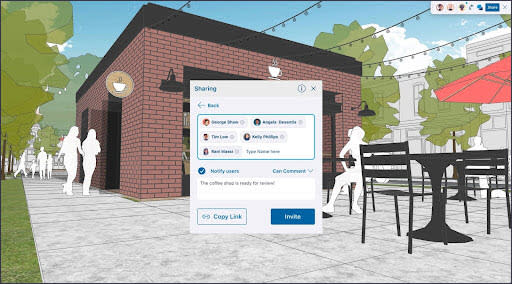
檢視者點開您分享給他人的連結,便會在他們的網頁瀏覽器中打開您的模型。檢視者有權存取基本資訊,並根據您設定的存取權限看到其他選項。您隨時都能設定或變更檢視者的存取權限。收到私人邀請的檢視者擁有以下權限:
擁有者 – 模型擁有者一律可完整存取全部的檢視功能。
檢視場景 – 能檢視模型中的各個場景,但無法自由瀏覽模型或留言評論。
評論 – 可留言評論、使用所有相機工具,並存取檢視者的所有公用程式。
「公開存取」權限則定義了當某人使用您的公開連結,或在無私人邀請的前提下,試圖存取並檢視您的模型時會怎麼樣。公開存取不包含在模型中留言評論的功能。模型的公開存取可設定為:
無權限 – 當他人嘗試存取您的模型時,他們會收到向您請求存取權限的提示。您可接著同意、拒絕其要求,甚或忽視!
檢視場景 – 透過公開連結存取的檢視者僅可瀏覽場景。
檢視模型 – 透過公開連結存取的檢視者可自由瀏覽與測量模型。
所有檢視者都能看到其他檢視者的游標。每個人都能在協作工具列中使用 「Hide Cursor(隱藏游標)」 (  ) 來隱藏那些游標。
評論
全新評論工具能在模型內建立 3D 評論標記。若要在自己的模型中留言評論,請從工具列或協作工具列啟用 「Comment(評論)」 工具 (  )。啟用後會開啟評論面板。您可在此檢閱留言串、新增回覆或隱藏評論標記。
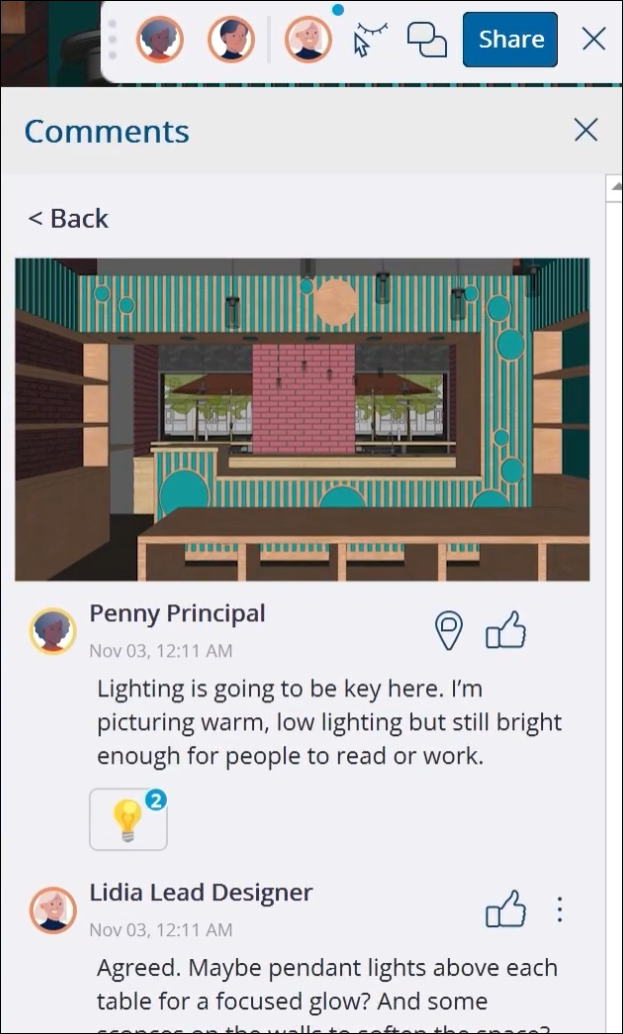
檢視者可透過評論工具留言評論。啟用評論工具後,您可以將游標懸停在物件上,並選擇要留言評論的精確位置。除了文字評論的交流外,您也能在留言串中新增圖片、連結,甚至不同的相機位置。
每則評論都能與特定場景建立關聯。這意味著每當檢視者點選建模視窗的評論標記時,SketchUp 將顯示該留言串、啟用最後選取的場景,並切換至該評論的相機位置。您也可選擇將評論與其他場景相關聯,或完全不指定場景。
即時檢視與相機控制
預設狀態下,檢視者可即時看到您的建模更新。您所做的任何變更都會對任何人顯示,若能看到游標,檢視者甚至能看到您正在使用的工具。檢視者正在使用的導覽工具,例如捲尺、平移或旋轉工具,也會對所有人顯示。
若您希望檢視者從特定視角查看您的模型,您可在協作工具列點選您的頭像。每位檢視者的視角都會切換成您的視角。如想查看其他檢視者看到的畫面,只需改點他們的頭像即可。
進一步瞭解
如欲深入了解 SketchUp 提供的所有新增協作功能,請參閱 「Connect and Collaborate(連結與協作)」 。
視覺化增強
我們做了什麼
SketchUp 26.0 新增環境光遮蔽的距離倍增器與顏色控制、可反轉材質粗糙度貼圖,以及材質縮圖自選等備受期待的功能。
詳細資料
環境光遮蔽
環境光遮蔽面樣式有兩項重大增強 – 包括 距離倍增器 滑桿與顏色樣本控制。
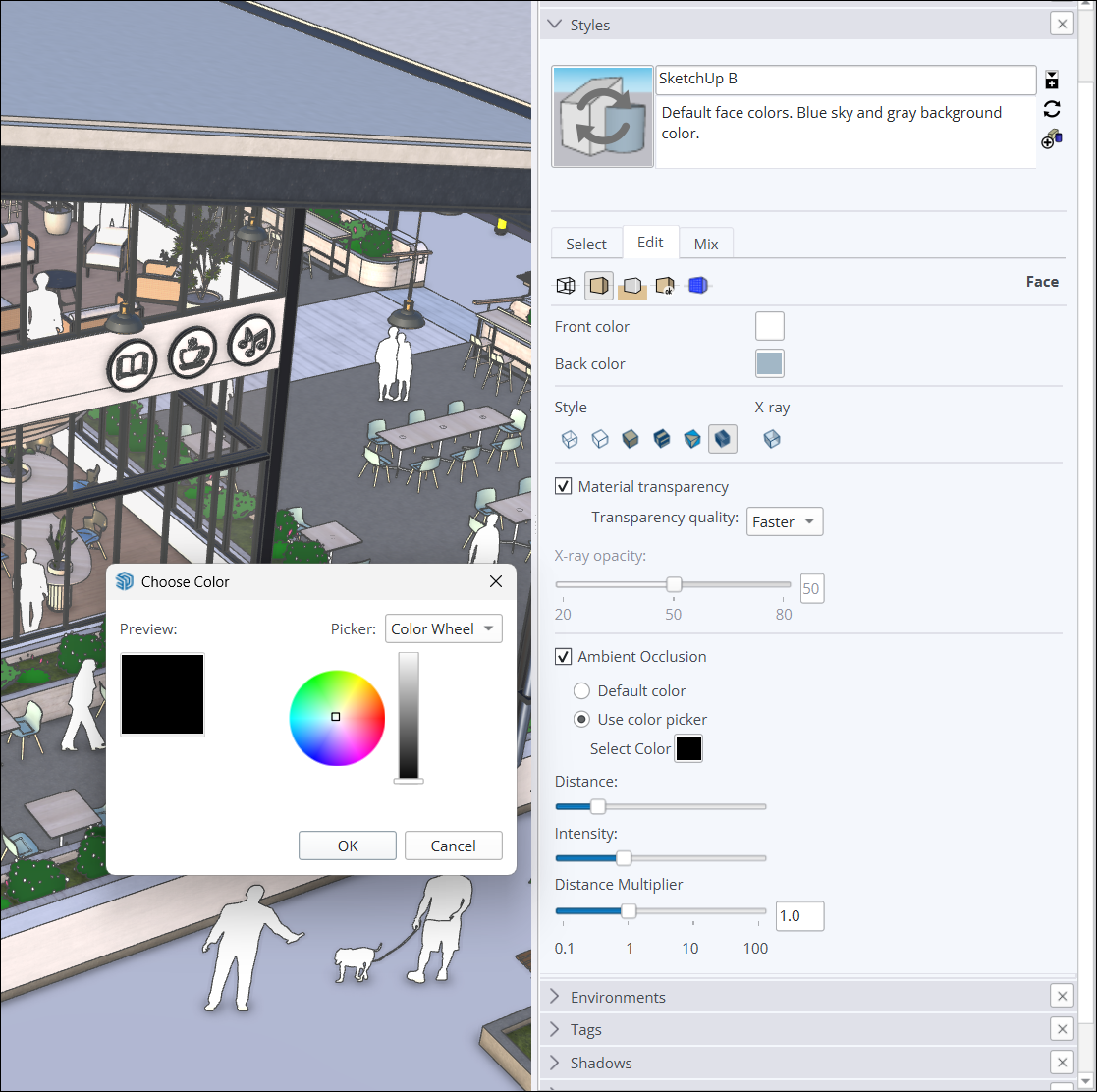
距離倍增器 滑桿可精細控制模型中遮蔽效果的呈現距離。數值愈高,畫面縮小時仍可看到遮蔽效果。
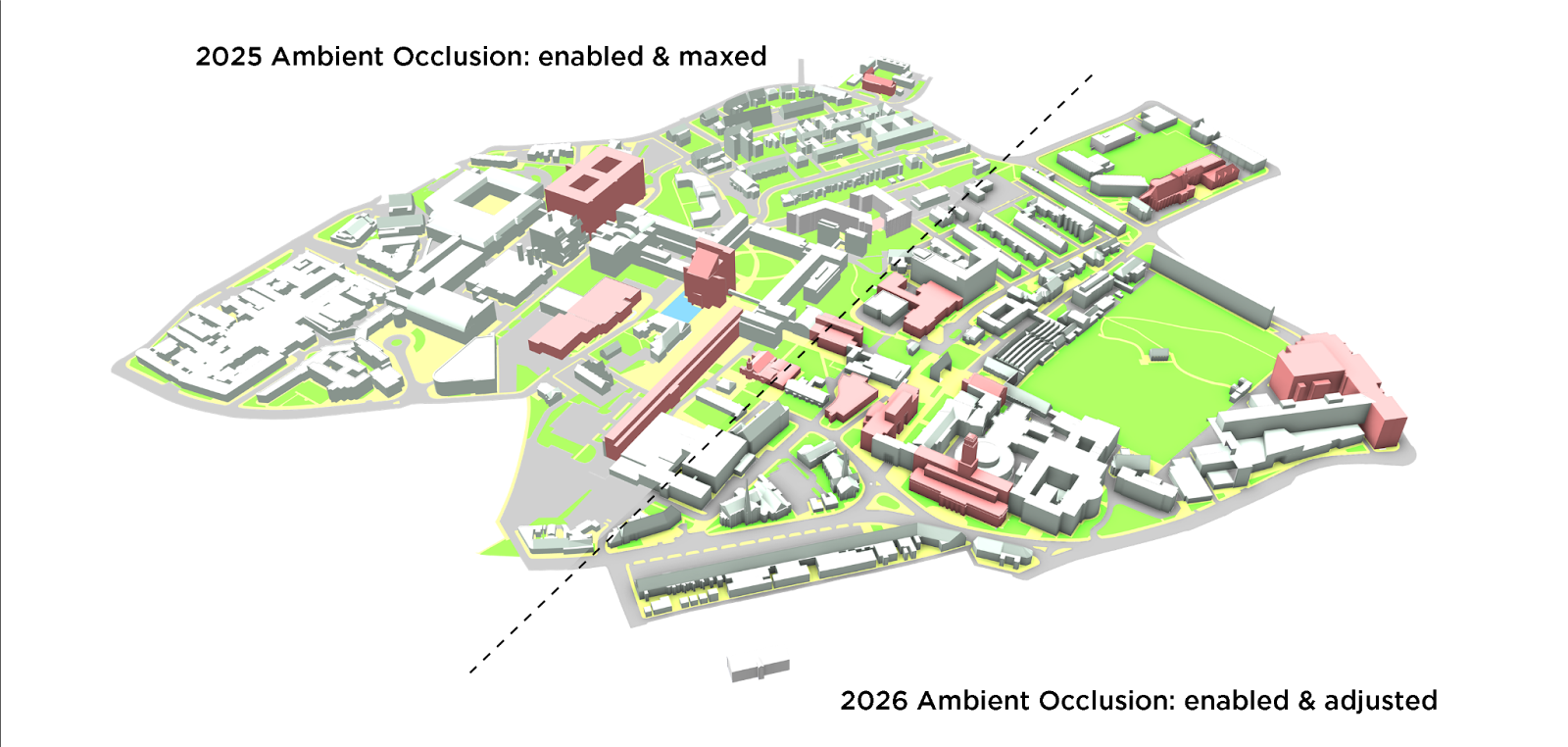
全新顏色樣本控制可依您選擇的顏色產生動態陰影效果。當您使用色輪、HLS、HSB 或 RGB 等控制項調整顏色,色彩效果將即時呈現在模型中。
反轉粗糙度
SketchUp 的「逼真材質」提供了自訂模型表面的外觀和質感的許多選項。透過新增的「反轉粗糙度」選項,您可以翻轉材質粗糙度貼圖的黑白值。反轉粗糙度為您提供了其他選擇,讓您充分控制表面的平滑或粗糙度。
材質縮圖(僅限 Windows)
因應大量用戶需求,材質縮圖現可自訂,同時支援立方體和 2D 平面圖像的顯示方式。
在材質預覽上按一下右鍵,即可於 「Auto Thumbnail(自動縮圖)」 、 「Cube Thumbnail(立方體縮圖)」 或 「Flat Thumbnail(平面縮圖)」 間進行選擇。選取「自動縮圖」時,逼真紋理將顯示為立方體;「立方體縮圖」則強制以立方體顯示材質;「平面縮圖」則以經典的 2D 圖像顯示縮圖。
進一步瞭解
如需了解更多 SketchUp 的視覺化功能,請參閱 「材質、紋理與環境」 。
效能
我們做了什麼
SketchUp 2026.0 全面提升記憶體管理與運作效率。這些變更讓 SketchUp 更有效率、更快速且更穩定,特別是在處理大型模型時。
詳細資料
記憶體增強
SketchUp 現已強化記憶體管理,針對多種元素與流程的記憶體配置與運用方式皆進行了優化,包括:
模型載入 – SketchUp 現在能以更高的效率載入模型資料,並縮減初始記憶體高峰。
降低記憶體負擔 – SketchUp 優化了元件的記憶體預留空間,從而減少記憶體浪費。
Windows 圖形資源效率 – Windows 使用者將注意到圖形資源分配的改進,進一步提升了記憶體使用效率。
經由這些記憶體改進,SketchUp 耗用的整體記憶體更低。這意味著:
特別是在記憶體空間較少的裝置上處理大型模型時,當機與凍結情形將減少。
系統更穩定、反應更即時,讓您安心長時間工作不中斷。
操作更流暢、反應更迅速。
工作效率提升
SketchUp 2026.0 強化了多項常用操作的速度,為下列增強功能提供了更流暢的操作體驗:
選取與推算 – 優化核心選取及操作代碼,大幅提升如選取、開啟或關閉元件,以及推算小型目標等作業速度。
場景切換 – 增強場景切換邏輯,讓大型模型的場景切換更順暢,並讓每秒畫格提升約 86%。
縮放範圍 – 使用「縮放範圍」時,速度提升約 90%。
清除未使用項目 – 清理未用標籤所需時間大幅縮短。
注意 :效能預估乃基於在不同硬體配置上以各種複雜度的模型進行的內部基準測試。實際體驗會依您的硬體及模型數據而異。
Learn More
For more information on running SketchUp see our Hardware and Software Requirements .
Live Components
What We Did
SketchUp 2026.0 adds additional Live Component gripping functionality to the Scale tool. These grips allow you to place and size Live Components by inference. We’ve also added several quality-of-life improvements to painting Live Components.
The Details
Scaling Live Components
The Scale tool ( ) can now be used with Live Components, allowing more flexibility when placing components in your models.
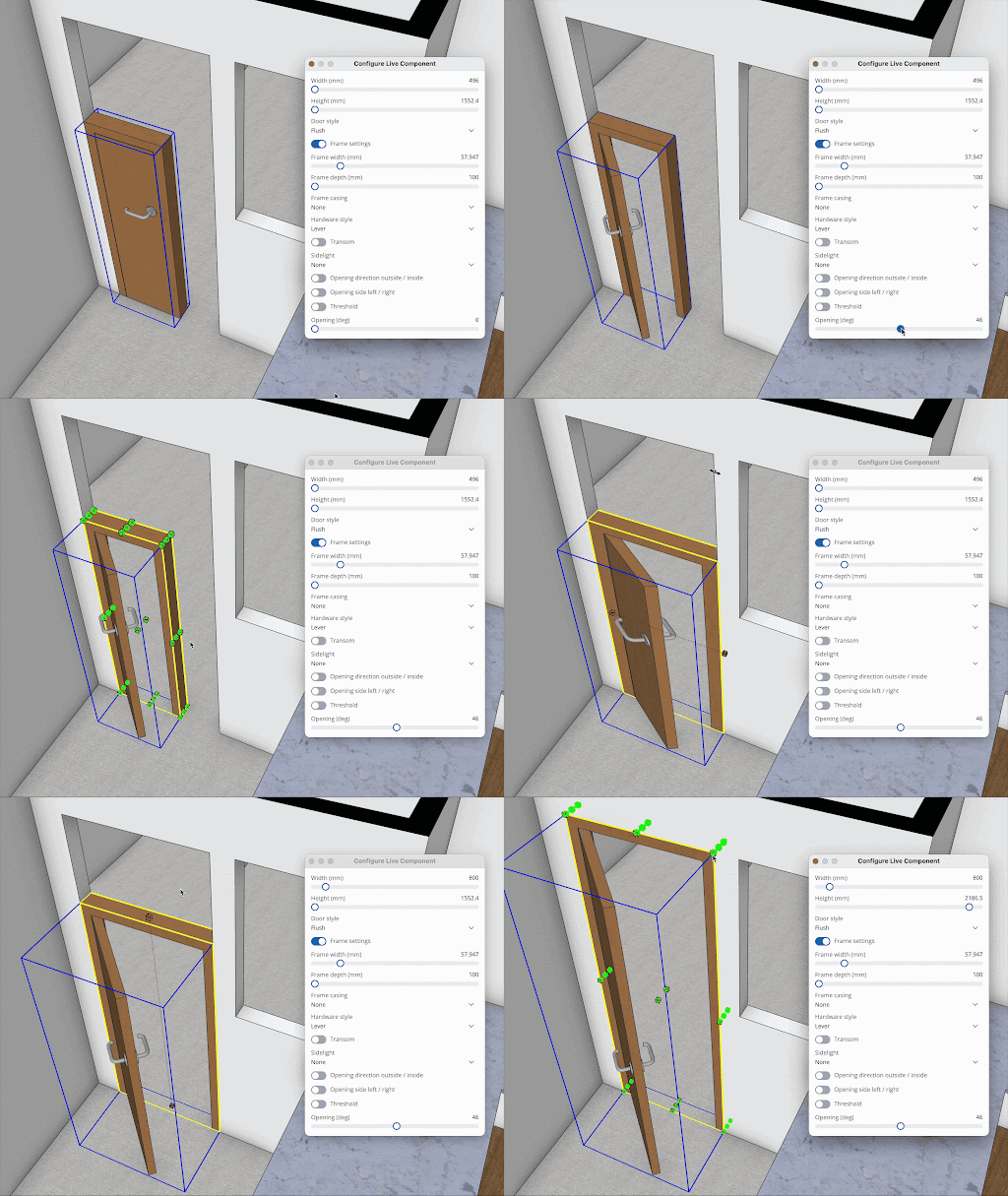
These grips are not always locked to the bounds of the component. That means you can better identify what you are sizing and how to best fit a component in your model. Check out 3D Warehouse’s SketchUp Content Library to browse sizable Live Components, available to SketchUp subscribers. Not all existing Live Components have scale grips, but more that do are coming soon!
Improved Material Workflows
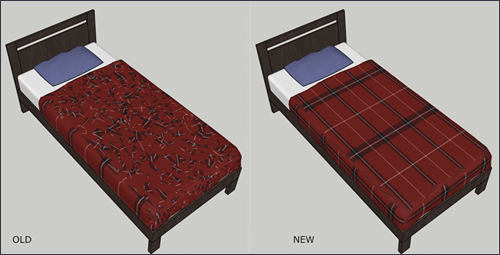
The Paint Bucket tool can apply custom materials to a Live Component, even materials not already available in that component. This updated workflow now includes better texture mapping, painting while a Live Component is selected, a better way of handling materials, and a few other behind-the-scenes changes to help with SketchUp Material Library compatibility.
Learn More
For more information see SketchUp Live Components .
General Modeling Improvements
What We Did
SketchUp 2026.0 includes several notable improvements across scaling, rotating, scenes, and inferencing.
The Details
Scaling Improvements
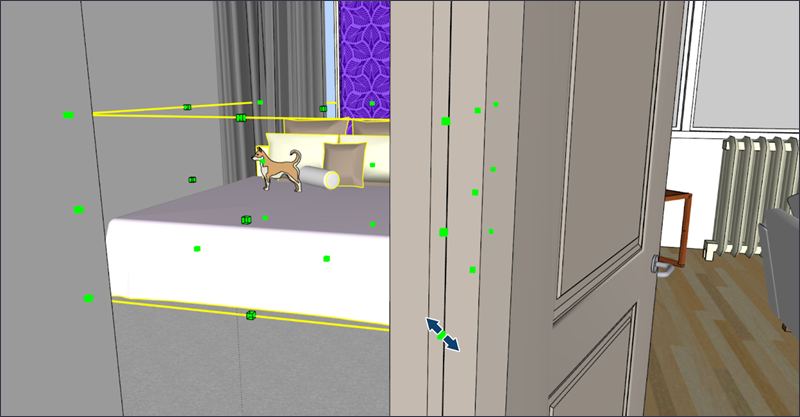
When scaling objects it can be hard to access grips hidden by other geometry without a lot of orbiting, panning, and adjusting visibility. In small spaces, scaling may require extra clicks. Now, scale grips display through other geometry, so that you can always see and click them.
Rotate Improvements
SketchUp 2025 introduced rotation handles to the Rotate tool. These handles allow for quick- two-click rotations, but cause unexpected results after locking the rotation plane. To avoid problems, rotation grips will not appear when you’ve locked a rotation plane.
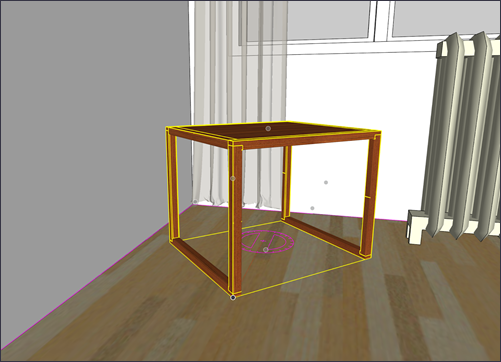
Moving from a profile edge
When placing objects, the object you are placing could obscure the background elements, making it hard to align things. Some workarounds include showing back edges, turning on X-ray, or cycling through bounding box grips.
To address these issues, groups and components can now be done using one of its profile edges. The object will become transparent, making it much easier to see and choose your placement target. Profiles don’t need to be visible for this to work, but still depends on camera position and the complexity of geometry.
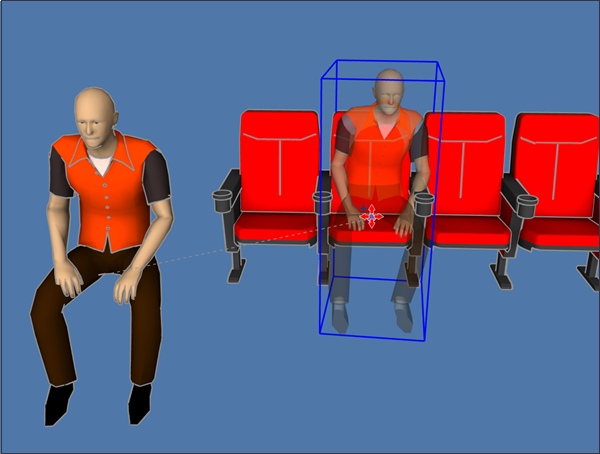
Scene Undo and Redo
Making the wrong update to a scene can be frustrating. Before 2026.0, it could require hours or discovering new extensions to get a scene back to where you want it. To address this issue, the ability to undo or redo scene updates is now available. Undo and Redo works just like it does when editing other parts of your model and will also respect creating, renaming, and deleting actions.
Purge Unused
The Purge Unused reminder seen when you save a model will now be off by default. You can still control this reminder in Preferences. When switched on, you can now control exactly what you want to purge, helping to make sure you aren’t purging useful assets. Purge Unused also appears in the Edit menu and can be assigned a shortcut, so that you can purge what you want, when you want.
Trays and Panels (Windows)
As part of ongoing work to update the SketchUp interface, you can control tray and panel visibility by right-clicking tray and panel headers. Selecting an unchecked panel makes it visible within the tray you clicked on. This new functionality is an alternative to using the Window menu whenever you want to activate trays or show panels within a tray.
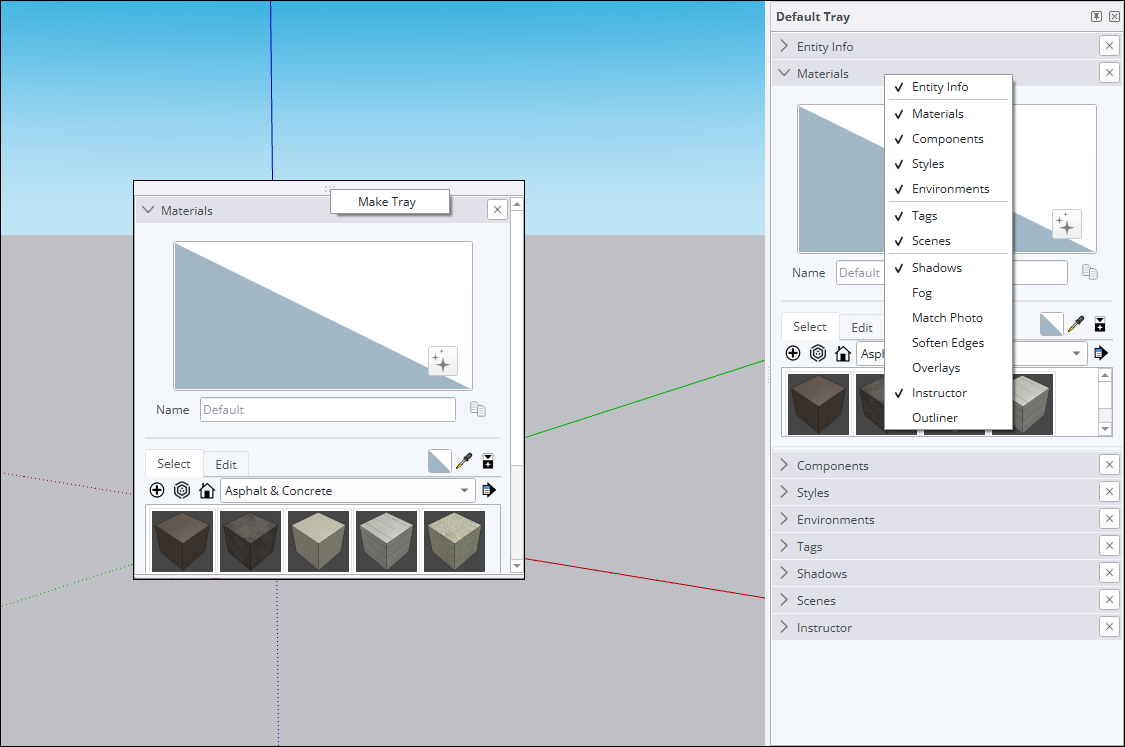
Additionally, panels can now be dragged between trays or out into open space to become an independent tray. If you want to turn that new window into a tray, you can context click the temporary tray click Make Tray .
Learn More
For more information on how to use these new features, see Drawing Lines, Shapes, and 3D Objects .
Manage Activations
What We Did
You can now reset all activations and authorize your current device without leaving SketchUp for Desktop.
The Details
Sketchup’s End User License Agreement (EULA) limits the amount of installations and authorizations for each application included in your subscription to two instances or devices. If you try to install and authorize an application on a third device or open a third instance of an application, you'll see the message "You have exceeded your allowed activations."
If you reach that message when opening SketchUp for Desktop, an option now appears allowing you to reset all activations and authorize your current device without having to access your account management page.
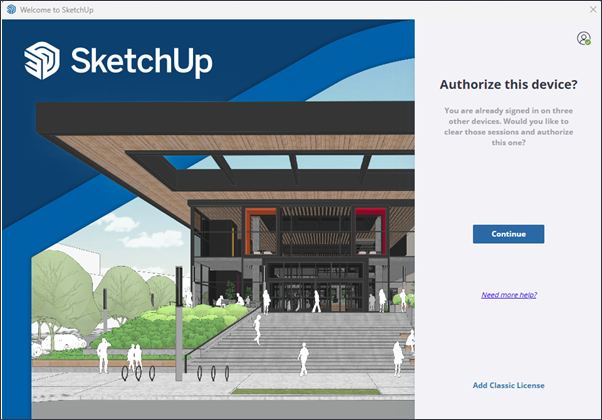
Learn More
For more details on how you can manage your activations, see Managing Activations .
SketchUp Interoperability
What We Did
SketchUp 2026.0 now offers several fidelity and efficiency improvements for importing and exporting DWG files. This includes hatch support and preserving section planes. The IFC export workflow has also been enhanced, consolidating IFC 2x3 and IFC 4 into a single file type with expanded Export Options.
The Details
DWG Import Options
When importing a DWG file, two new options are now available – Import Layers as Groups and Import Linework Flattened .
Selecting Import Layers as Groups tells SketchUp to create groups corresponding to the imported DWG’s layer structure. These imported layers still have their own Tag, but now also have corresponding, grouped geometry allowing for improved visibility control in your imported model.
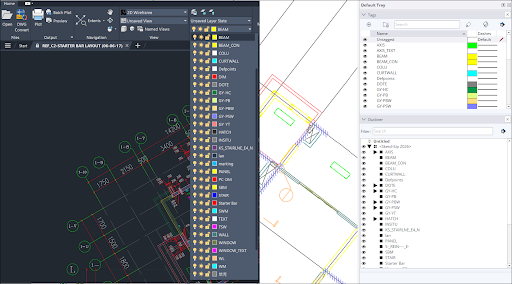
Selecting Import Linework Flattened sets the Z-value of imported geometry to 0, decreasing the common post-import cleanup needed when converting 2D CAD data into 3D models. By eliminating Z-axis discrepancies, the tool prevents disruptive issues like misalignments and helps you start with a clean, accurate foundation. If you are familiar with other CAD software, this works a lot like the Flatten feature found in those applications.
DWG Hatch Support
Sketchup now imports hatches from DWG files. Imported solid hatches become faces. Non-solid hatches become edges.
Exporting 3D Sections
SketchUp now preserves section planes when exporting 3D DWG files, resulting in DWG Sections. These sections can then be used with the Generate Section Block and 2D Section / Elevation features in AutoCAD.
Other DWG Improvements
SketchUp 2026.0 also includes the following DWG improvements:
Polylines from DWG files now import as welded SketchUp lines.
SketchUp now better handles component instance names, reducing duplicative data.
3D Polyline now appears as intended in the Import Results dialog.
Better results when exporting true curves.
Multiple issues with the 3D AutoCAD exporter were addressed.
3D polylines now export as intended to 2D DWG.
IFC Exporter Improvements
When exporting your model, the IFC 2x3 and IFC 4 options are now consolidated into a single IFC File option in the list of file types. You can then select a specific IFC version in the new Export Options dialog.
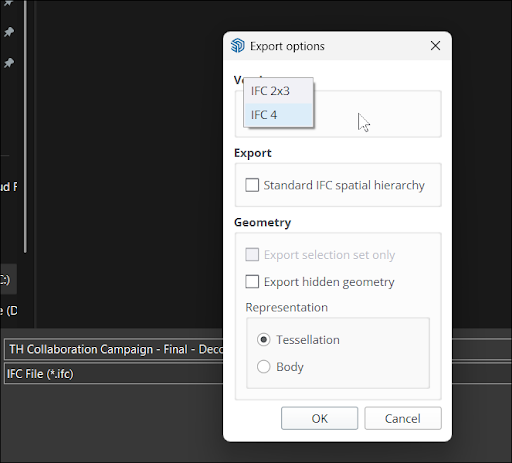
The new IFC Export Options dialog also includes a new Standard IFC Spatial Hierarchy option. Selecting this option creates essential entities like IfcProject, IfcSite, or IfcBuilding, even if they aren’t defined in your model’s Outliner structure.
Learn More
For more information on importing and exporting with SketchUp, see Using SketchUp Data with Other Modeling Programs or Tools .
Scan Essentials
What We Did
Scan Essentials includes two new point cloud modeling workflows, the Texture Projection and Mesh Generation tools, a new Scene Manager to better control the visibility of point clouds in both SketchUp and Layout, and the ability to reset transformations to the original georeferenced coordinate system when exporting.
The Details
SketchUp subscribers with access to Scan Essentials can now use two new tools – Texture Projection and Surface Mesh.
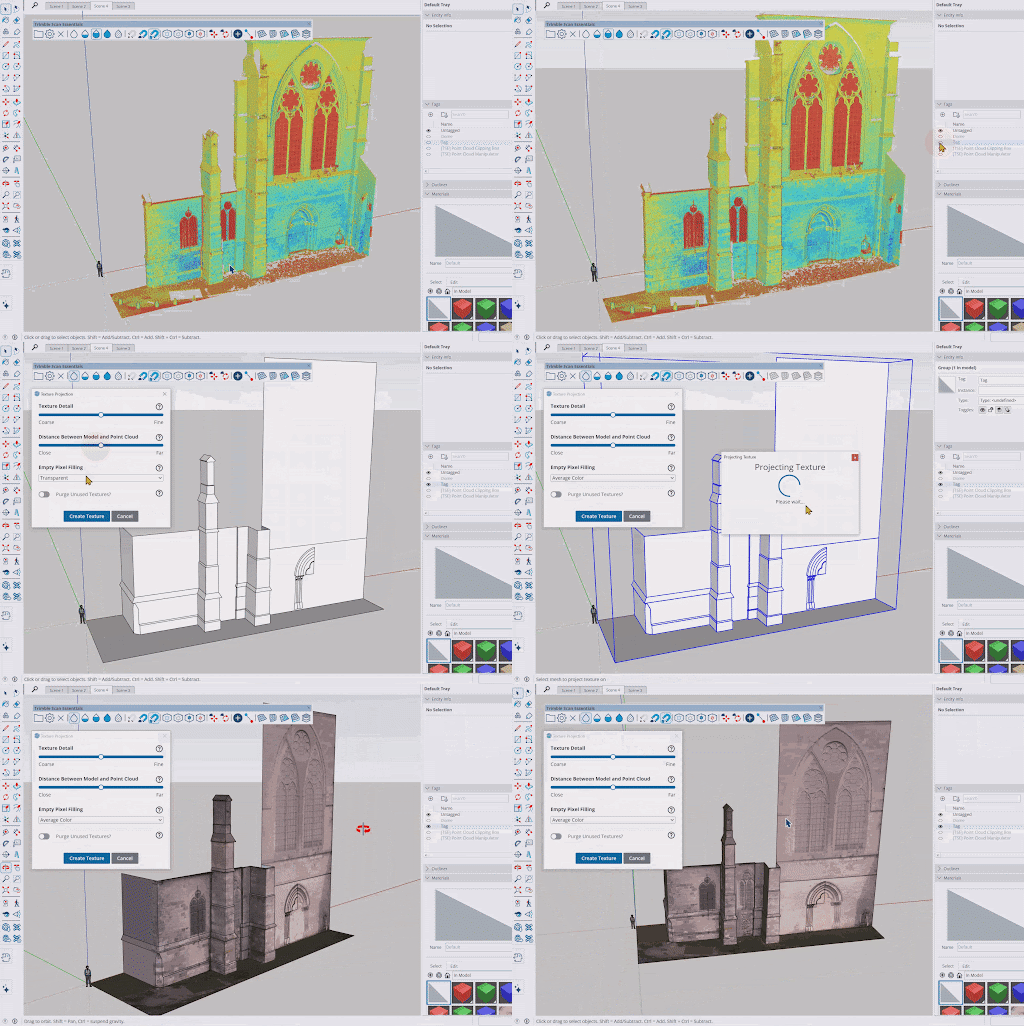
With Texture Projection, you can extract an image texture from scan data and project it onto SketchUp geometry. Projected textures turn into SketchUp materials you can reuse in other parts of your model, or even other models if you save them.
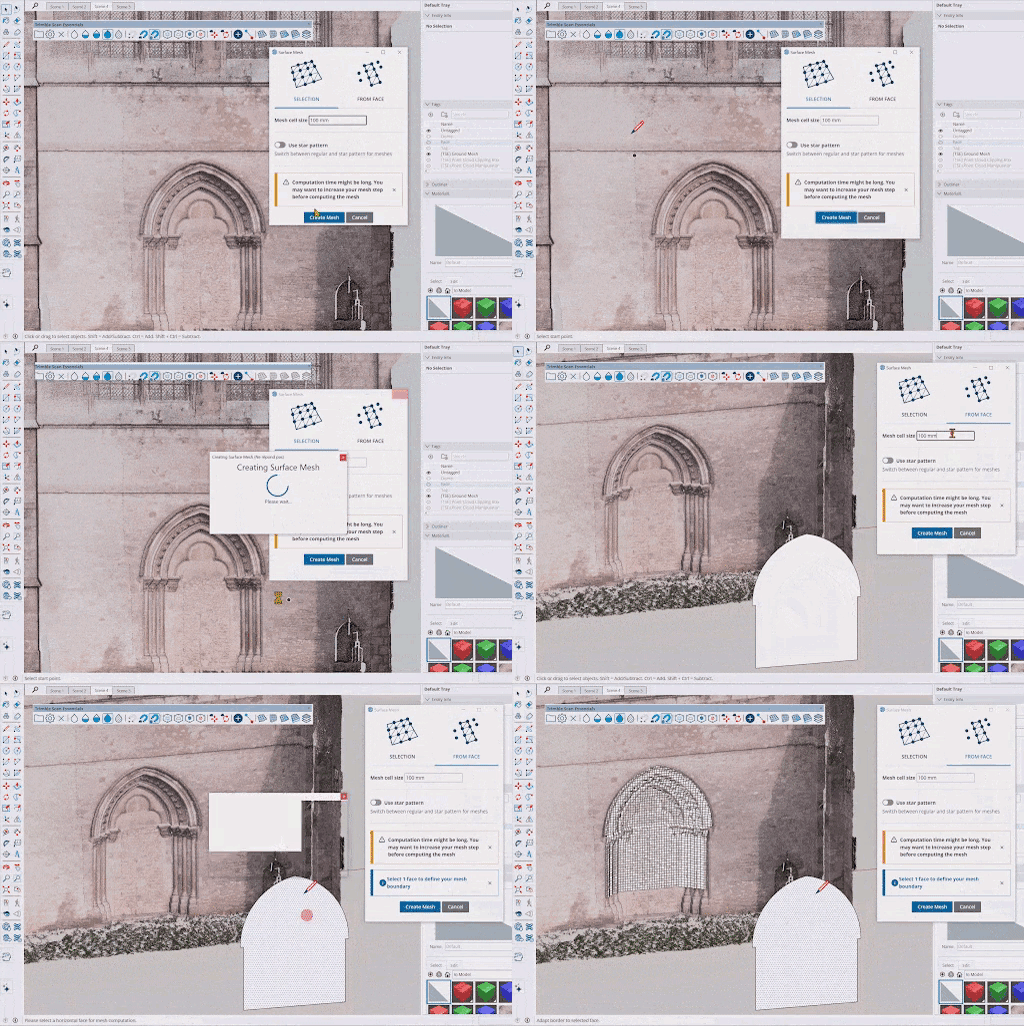
The new Surface Mesh tool makes extracting Sketchup geometry from point clouds easier. After selecting the Surface Mesh tool you can choose the area you want to extract from, define how you want to extract the geometry, and create a mesh in just a few steps.
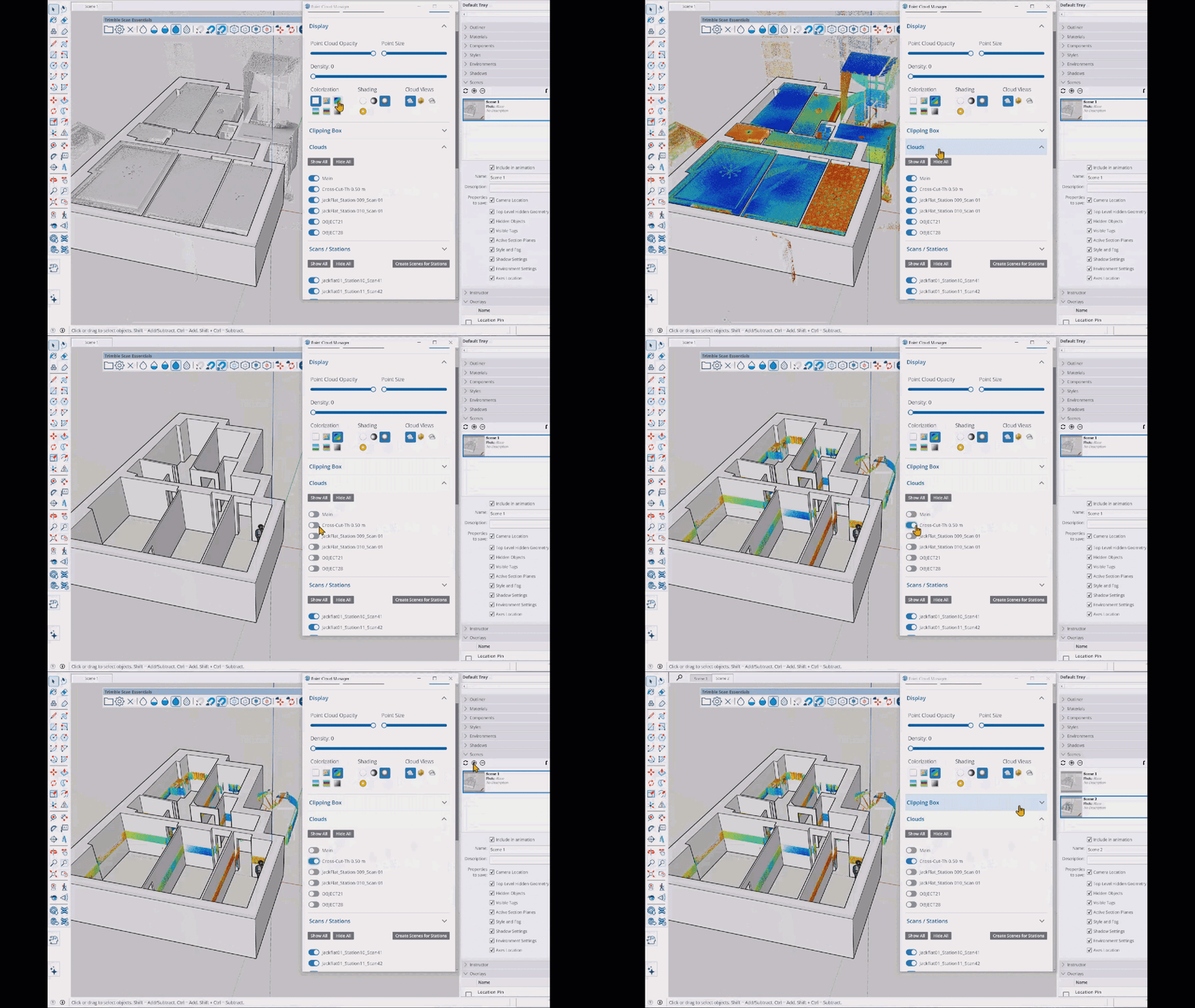
Along with these new tools, you can now save visibility settings from the Point Cloud Manager as a scene in both SketchUp and LayOut.
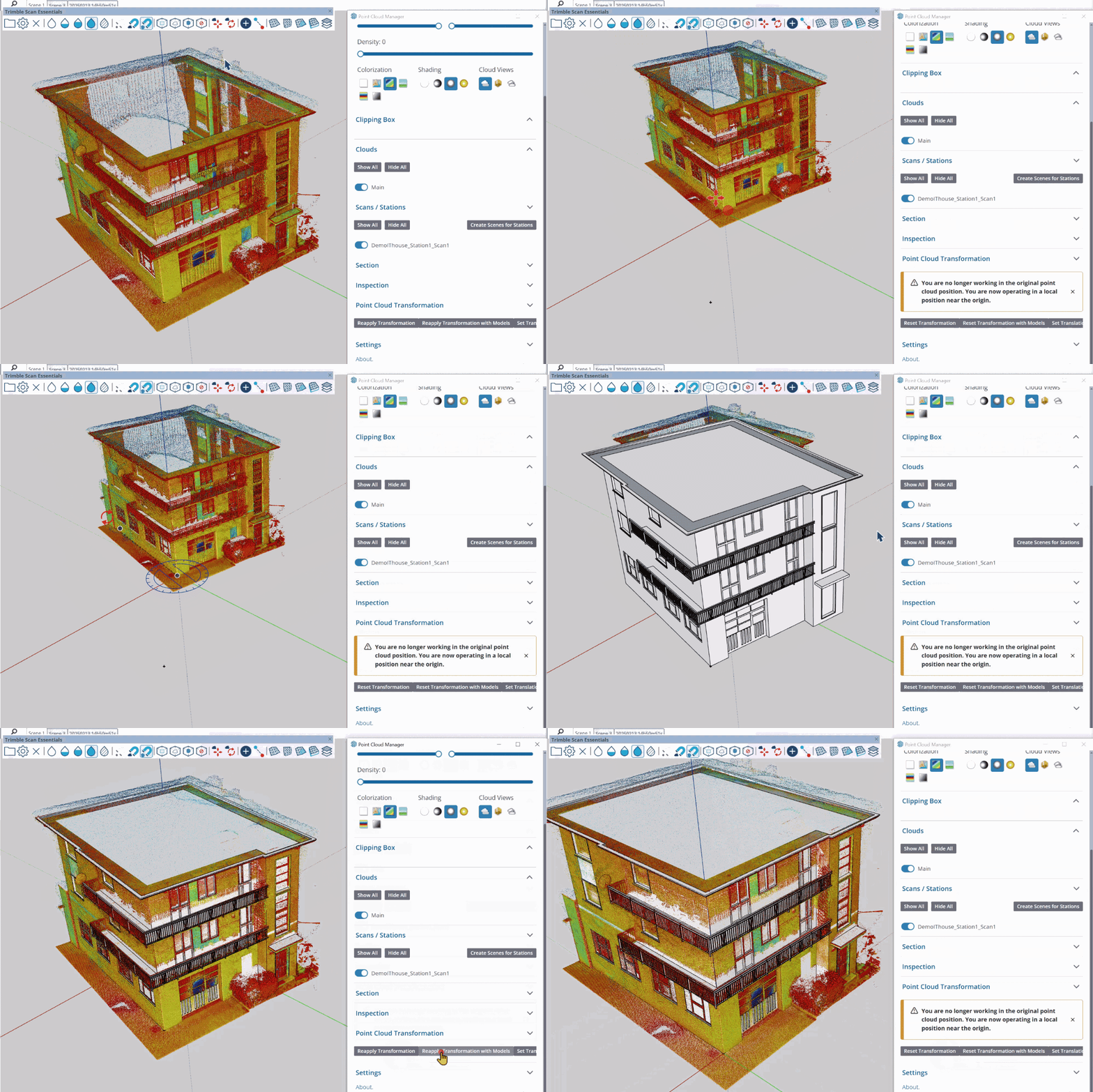
Finally, clicking Reset Transformations in the Point Cloud Manager now resets all transformations, including global transformations. This can be a great tool for those who want to export their original data for use with other apps.
Learn More
For more information, see Scan Essentials for SketchUp .
LayOut
LayOut Interface and Performance Updates
What We Did
The LayOut interface on Windows looks and operates more like SketchUp with updated iconography, tray and panel configurations, and toolbar customization.
The Details
LayOut’s new interface on Windows brings SketchUp style to your LayOut documents.
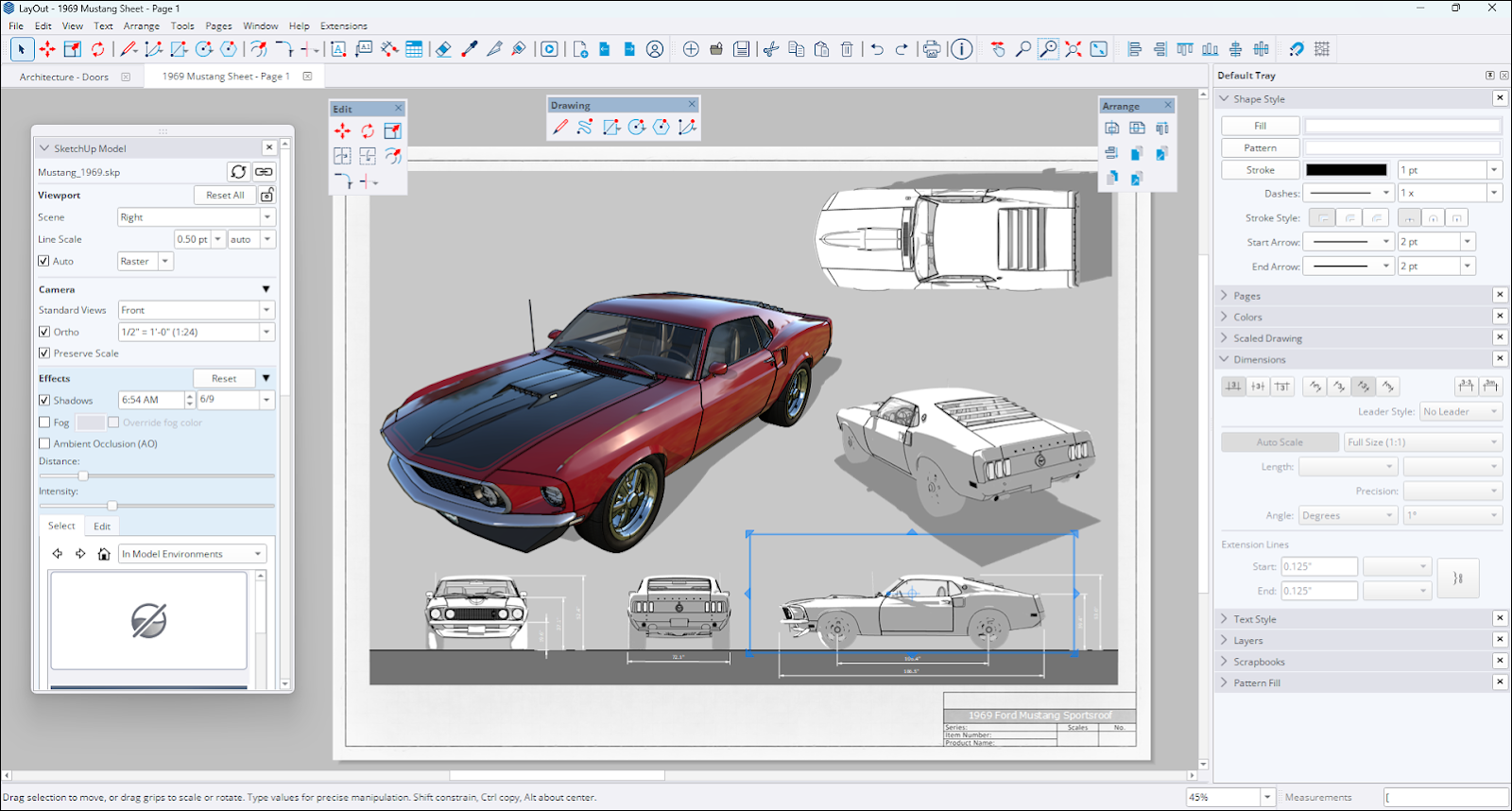
LayOut’s trays and panels now behave a lot more like their SketchUp counterparts. You can arrange them in your workspace, drag panels out, and create new trays to best fit your workflows. Toolbars received a similar uplift, allowing you to arrange them how you like in your workspace, similar to how it works in SketchUp.
Vector and Hybrid Rendering Performance
LayOut’s Hidden Line Rendering (HLR) code generates the vector linework used in vector and hybrid SketchUp model viewports. We’ve improved this process granting a significant speed increase.
Learn More
For more information see Creating Documents in LayOut .
LayOut Drafting Tools
What We Did
Four new drafting tools, Trim, Extend, Fillet, and Chamfer, are now available. These tools provide a more intuitive and effective way to create and manipulate 2D vectors.
The Details
LayOut’s new drafting tools can help bypass unnecessary selections and eliminate extra cleanup when performing simple 2D tasks like detailing and diagramming. Each of these tools performs a specific function:
Trim (
 ) – The Trim tool provides an efficient way to clear lines or shapes without the need to clean up additional vectors. Trim removes excess lines and creates clean intersections, improving both speed and accuracy. The default shortcut for Trim is Shift + T.
Extend (
 ) – The Extend tool simplifies 2D drafting by providing a quick and easy way to extend lines and other entities. The default shortcut for Extend is Shift + E.
Fillet (
 ) – The Fillet tool creates precise rounded corners between two entities based on a defined radius. The default shortcut for Fillet is Shift + F.
Chamfer (
 ) – The Chamfer tool adds a 45° angle between two lines at a defined distance. The default shortcut for Chamfer is Shift + C.
These tools can be found in the Main Toolbar. Trim and Extend share the same spot in the toolbar with a dropdown available to switch between the two. Fillet and Chamfer also share one toolbar icon.
Learn More
For more information see Using the Drafting Tools .
Scrapbook Improvements
What We Did
LayOut’s default Scrapbook libraries now include 2D Windows, Doors, Furniture, Kitchen, Bath, and People under the Architecture category.
The Details
The Scrapbook libraries shipped with LayOut provide common reusable elements that are simple to add and scale in your drawings. We’ve now added a new Scrapbook called Architecture. This new Scrapbook offers common architectural assemblies that work well with model viewports or plans drafted within LayOut.
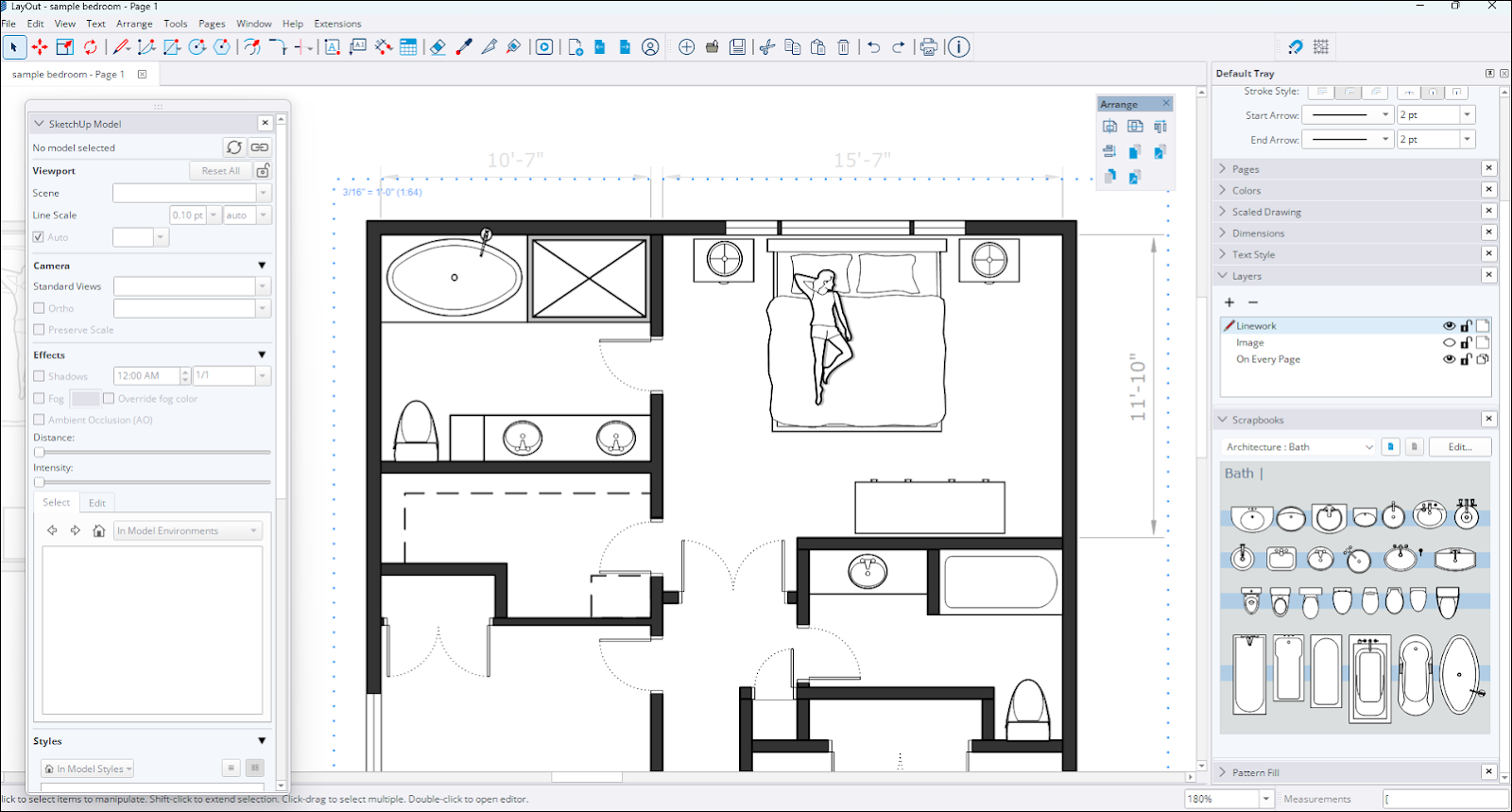
This new Architecture Scrapbook contains elements of the following types:
Doors with Wall Mask (Doors created with a rectangle ‘Masking’ out entities below)
Doors
Windows
Living
Bedroom
Kitchen
Bath
All the Architectural Scrapbook content is created as customizable Scaled Groups.
Learn More
For more information on the existing and new Scrapbook libraries, see Working with Scrapbooks .
LayOut Importing and Exporting Improvements
What We Did
LayOut 2026.0 brings multiple updates to DWG functionality, improving efficiency in how LayOut imports and exports your document using that file format.
The Details
If you use AutoCAD as part of your 2D workflows, LayOut can help you create and maintain drawings. LayOut received quite a few improvements to help when working with DWG files:
Page Export – When exporting a LayOut document you can now export each page in your document as a distinct DWG file.
Tag Preservation – Exporting to DWG now preserves tag naming structures of your SketchUp viewports.
Stacked Viewports – When multiple SketchUp viewports are located in the same position in your document, these models will now also be stacked on top of each other in the exported DWG model space.
Text, Hatches, and Tables – LayOut now accurately exports text, hatches and tables to DWG. This includes proper AutoCAD table elements with font and border settings. LayOut also better recognizes and imports these elements when importing a DWG into your document.
Broken Lines and Curves – LayOut now properly creates continued lines for elements exported from SketchUp viewports.
Learn More
For more information see Importing CAD Data into LayOut and Exporting CAD Data from LayOut .
Bug Fixes and Other Improvements
SketchUp
Stability and Performance
Fixed an issue where opening or expanding the Components tray while using tools like Paste, Component, Move (in Copy or Stamp mode), or Rotate (in Copy mode) would cause a crash.
Added the ability to change the material preview (flat, cube or automatic switching) style via a context menu
Added the ability to set a custom directory for templates in Preferences
Improved automatic association of .skp files. When multiple versions of SketchUp are installed, .skp files now correctly default to opening in the latest installed version.
Addressed an issue where notifications could be triggered three times through the Ruby API, but would fail on the fourth.
Fixed intermittent crashes when editing Live Components.
Improvements have been made to handle model corruption that previously showed a ‘file invalid’ error, with more cases now being automatically fixed.
A crashing issue that could occur when importing very large images while the new graphics engine was active has been fixed.
Improved V-Ray integration by allowing version specification on the download page.
Resolved a crash that occurred with certain example files when specific groups were selected and then exploded from the context menu.
Fixed a crashing issue that could happen if a model being opened had a corrupt Normal map.
Implemented better performance when selecting large areas of complex models.
Fixed a crash that could occur when copying text objects that used the auto-text feature.
Addressed a crash that could happen when using the Create Radius extension.
Dragging a corrupt component into the model scene from the Components panel will no longer cause a crash.
Certain components will no longer flicker while using the Orbit tool.
A crash that occurred during the import of a specific hatch has been fixed. Additionally, resolved an issue where the back and front faces of certain geometry were reversed during import.
Corrected a bug in the Component Options dialog where default attribute values from custom SKC files were not being imported by updating the import mechanism to correctly parse and assign these values from the XML schema.
Addressed an issue where notifications could be triggered three times through the Ruby API, but would fail on the fourth.
MacOS – Fixed an issue where CMD + Tab could cause tool interruptions when tabbing away from and back into SketchUp. SketchUp will no longer lose inferences or drawn lines when performing this action.
Windows – Added tool icons next to many items in the application menus
Windows – Fixed an issue where Ruby SketchUp would crash when an HtmlDialog was called from a WebDialog.
Windows – Fixed an issue on Windows where SketchUp would crash on launch after a period of inactivity.
Usability
Extension Migrator is now pre-installed and automatically launches on your first install, prompting you to migrate extensions from a previous installation.
Author is changed to "SketchUp" for Extension Migrator for consistency with other shipped Extensions.
Fixed an Extension Migrator issue where "\r" would appear in text strings in some translations, including French.
Reset Workspace in Preferences > Workspace now restores SketchUp’s out-of-the-box workspace as intended.
The initial import directory is now saved to File > Preferences for all 'import to model library' options (Materials, Environments, Styles).
Fixed an issue where Environments would not download directly into the model from 3D Warehouse
Fixed an issue where downloading an Environment from 3D Warehouse and importing a .ske file used the incorrect name.
Fixed an issue with a mismatch in the English resource folder path which resulted in an error in the Welcome Window.
A bug that could cause the Escape key to fail to exit from group or component editing mode has been fixed.
Fixed an issue where scene thumbnails would show a '?' instead of updating when changes were made in a Match Photo scene.
Improved the status bar text for painting Live Components. The Live Component can now be selected at the time of painting.
Fixed an issue where components with a corrupt transformation would disappear when scaled.
Improved the time it takes for the Live Component configuration panel to appear when switching between different Live Components.
Text or dimension elements now correctly show the assigned tag color when selecting Color by Tag .
Corrected an inaccurate bounding box report for groups that had been transformed with Ruby code.
Fixed an issue where materials used as tag colors were not appearing when using the Hidden Line face style with the new graphics engine enabled.
Addressed an issue where drawing a rectangle would show a help tip about squares, but the resulting rectangle was not a square.
The status bar text for the Lasso tool now displays as intended in languages other than English.
Objects set to glue to faces, when placed with the Move tool in Stamp mode, will no longer incorrectly rotate by 180 degrees.
Fixed an issue in tools where using the protractor could cause it to appear larger than normal.
Fixed an issue when navigation buttons were sometimes hidden when launching 3DWarehouse or Extension Warehouse.
Fixed an issue where dimensions inside a component being scaled would not update, and where the arrows would look stretched.
Fixed a crash that could occur when opening a model that had a corrupt style, or when choosing the Save Out > To 3D Warehouse option.
Fixed a flickering issue that could occur when animating between scenes with different section plane settings.
Fixed a crash that could occur while drawing by click-drag-release while using the Move tool’s Stamp mode.
Fixed an issue where resetting the scale of a group would make the contents disappear.
Fixed an issue where some animations weren’t always visible when transitioning Scenes with the New Graphics Engine.
Fixed an issue where some error messages were confusing or non-descript of what to do next.
Windows – A keyboard shortcut has been added in Preferences to show the Environment panel.
Windows – The tag color preview in the Tags panel now correctly displays textures instead of only a solid color.
Windows – An issue where having many scene tabs would cause the wrong scene to be selected when clicking on a tab has been fixed.
Windows – The materials panel no longer unexpectedly opens and scrolls when reactivating the Paint Bucket tool after using a camera tool.
Windows – The Create Material and Duplicate Material dialogs now show all controls when a scroll bar is present.
Windows – Pressing Enter/Return in text edit fields in the material panel now returns focus to the main window as expected.
Windows – Fixed an issue where copying text from the Ruby console would add another component in the viewport.
Windows – Fixed an issue where exported 2D images showed the background color through holes in the ground when the new graphics engine was enabled.
MacOS – An issue preventing the exploding of multiple Tag folders at once has been fixed.
MacOS – Fixed an issue where the materials dialog would jump to the top of the screen when editing an in-model material.
MacOS – Fixed a problem where if two materials had the same name, the first one would incorrectly appear where the second one was applied.
MacOS – Addressed issues in materials that could lead to a crash when an affected material was duplicated.
MacOS – Fixed an issue where thumbnail previews in file explorer are not generated when saving files.
MacOS – Fixed an issue where closing the SketchUp window, intentionally or unintentionally, during an upload to Trimble Connect blocked the ability to quit SketchUp, requiring a force quit.
LayOut
Interoperability and Organization
When exporting LayOut files to DWG, the tag name structure will now be maintained. - Existing files will require a re-render of SketchUp model viewports for the new export behavior to take effect.
Fixed an issue that could cause the camera to shift when scale-copying SketchUp model viewports from the top or left grips.
Addressed a bug where text justification could be changed for dimension text when a file was opened in a different version of LayOut.
A bug where a scaled drawing in a group could be resized, causing paper-space measurement errors, has been fixed.
Fixed an issue which would cause line paths being used as attached leaders to jump if the path was duplicated and then the entity was moved.
Fixed a sun location issue where the sun’s location would not update in a model that was a viewport in a LayOut page.
You can now export each LayOut page as a separate DWG file, named with the logic: "Layout file name_Page number_Page name."
Stacked SketchUp Model Viewports in LayOut will now be accurately exported in the same stacked position within the DWG model space.
Addressed a bug where importing large DWG files into LayOut with a scale less than 1:1 caused text and leader entities to appear with an incorrect size and position.
Windows – Fixed an issue that would show references in the Document Setup dialog for the wrong file when working with multiple documents in tab groups.
Windows – Fixed an issue where a model’s section plane symbols would not show when the model was in a LayOut document viewport.
MacOS – Fixed an issue where autotext in dimensions would be shortened or truncated after saving and reopening a file.
UI and Stability
Fixed an issue that could cause a 107 Error when saving a file after purging a pattern fill that was used in a clipping mask.
A crash that could occur when updating a model reference while on a blank page in the document has been fixed.
Fixed a bug which applied a double-click offset to the outside of an entity instead of inside.
Fixed an issue where snapping and inferencing could occur on parts of a model that were obscured by a clipping mask.
More issues related to font size and alignment discrepancies when using the Experimental Graphics Engine have been fixed.
An issue that prevented the creation of horizontal or vertical linear dimensions via the Ruby API has been fixed.
Fixed the behavior of dimensions on text entities to allow dimensioning text when there is a Stroke style applied to the text.
Windows – Fixed a crash that was caused by a third-party library when loading certain images in LayOut.
Windows – Fixed an issue where white text would become transparent while editing when using the Experimental Graphics Engine.
Notable Known Issues
Updating Table References may result in the wrong row or column data being updated. This can be fixed by setting the cell range through the Table Reference Options context menu dialog.
Localization
Addressed a number of localization issues including missing translations, incorrect product names, and broken links in our translated End User License Agreement (EULA).
Mitigated an issue that caused localized strings to revert to older translations. This regression affected all non-English languages, overwriting previously approved translations.
Fixed an issue where scrapbooks were missing when installing in languages other than English.
Interoperability
Importers & Exporters
DAE
Component and material names are no longer ignored by the importer.
DWG/DXF
Resolved an issue where importing DWG files created duplicate data by importing both Component Instance and Component Definition names.
Polylines from DWG files now import as welded SketchUp lines for more predictable behavior.
Fixed an issue that prevented 3D DWG files from exporting correctly. While DWG files now maintain proper geometry and sections, we are aware that active cross-sections created in SketchUp may not be visible when the file is opened in AutoCAD. We're continuing to investigate this behavior to ensure full section display in all compatible applications.
3DS
Corrected an underlying issue that caused exports to the 3DS format to fail with certain models.
IFC
All IfcSpace attributes can now be roundtripped.
Corrected an issue that caused broken or missing geometry when importing certain IFC files.
Custom SketchUp metadata, introduced in 2025, is now supported in Trimble Connect.
IFC Roofs, Stairs and Ramps attributes were updated to comply with buildingSMART Validation Service compliance.
IFC Export: Resolved an issue that caused Korean and Japanese characters to become corrupted in IFC exports due to incorrect multi-byte character processing. The exporter now correctly handles these characters using consistent UTF-8 encoding.
USDZ & TRB
Fixed a bug that caused textures to be lost when uploading models to Trimble Connect.
The USDZ import library has been updated, fixing an issue where files from phone scans would appear black by using emissive textures as a fallback.
Resolved a bug that created invalid USDZ files that failed to load in external viewers and corrected color mapping to ensure colors match the original SketchUp file.
An issue that caused TrimBIM (.TRB) file sizes to increase with each export attempt has been resolved.
API Release Notes (Ruby & C API)
Breaking Changes
Undoable Scene Operations
In SketchUp 2026.0 adding, deleting, and modifying scenes is now an undoable operation. Previously, these operations were not included in the undo stack. Now, if an extension modifies scenes using the API, an operation will be added to the undo stack. If these scene modifications are not called inside of an undo operation, extensions will inadvertently be adding extra operations to the undo stack.
We are asking developers to update and test their extensions that work with scenes. Please make sure to wrap all your scene operations between Sketchup::Model#start_operation and Sketchup::Model#commit_operation so that your extension does not flood the undo stack. Please test that you are able to update your extension to work as expected, and report any issues you might find to centercode early in the beta cycle.
Modifying the properties Sketchup::Axes, Sketchup::Camera, Sketchup::RenderingOptions, and Sketchup::ShadowInfo of a Sketchup::Page is now an undoable operation.
Scene changes must now be called between Sketchup::Model#start_operation and Sketchup::Model#commit_operation to avoid flooding the undo stack. This is an important new dynamic and we will start requiring this for extensions submitted to Extension Warehouse. Extensions not following this will be rejected from the Extension Warehouse.
Non-invertible transformations
{Sketchup::ComponentInstance#transformation=}, {Sketchup::ComponentInstance#transform!}, {Sketchup::Group#transformation=}, {Sketchup::Group#transform!}, {Sketchup::Image#transformation=} and {Sketchup::Image#transform!} no longer accepts non-inversible transformations (typically a transformation scaling to 0 in any axis).
{Sketchup::Entities#transform_entities} can no longer apply non-inversible transformations to {Sketchup::ComponentInstance}, {Sketchup::Group} and {Sketchup::Image}.
Crash Fixes
Fixed a crash in Layout::SketchUpModel when trying to render a model with an environment before the viewport was added to a Layout::Document.
Fixed a crash on quit when using Sketchup.send_action in an HTML dialog on_close event.
Fixed an undo crash related to using Sketchup::Classifications#load_schema and Sketchup::ComponentDefinition#add_classification in the same operation.
Resolved a crash that occurred during a transaction rollback triggered by an undo in the UI.
Windows – Fixed a crash during model.place_component().
Windows – Addressed a crash when placing an Empty Component Definition in SketchUp.
API Improvements
SketchUp Ruby API
Sketchup::Model#export now uses a new IFC exporter with new options (:ifc_version, :standard_ifc_hierarchy, :selectionset_only, :tessellated_geometry) and unsupported options (:doublesided_faces, :ifc_mapped_items, :ifc_types).
Added Sketchup::Model#active_section_planes and Sketchup::Page#active_section_planes.
Added Sketchup::Styles#remove_style and modified Sketchup::Styles#add_style to return the added style.
Added :show_version_warning_dialog optional argument to Sketchup.open_file.
Added Sketchup::Pages#unique_name.
Sketchup::Page#name= now automatically adjusts the name to make it unique if the given name is already in use.
Sketchup::ComponentDefinition#save_as and Sketchup::ComponentDefinition#save_copy now returns false if the save fails.
SketchUp C API
Added SUModelGetActiveSectionPlanes and SUModelGetNumActiveSectionPlanes.
SUEnvironmentCreateFromFile now allows an empty name parameter.
LayOut Ruby API
A new optional parameter for Layout::LinearDimension#initialize allows specifying the dimension line's alignment on creation (DIMENSION_LINE_ALIGNED, DIMENSION_LINE_VERTICAL, DIMENSION_LINE_HORIZONTAL).
Added Layout::LinearDimension#leader_line_visible?.
Added Layout::Style#text_strikethrough and Layout::Style#text_strikethrough= with constants (STRIKETHROUGH_NONE, STRIKETHROUGH_SINGLE).
Added API for LayOut Attribute Dictionaries:
Layout::Document#set_attribute
Layout::Document#get_attribute
Layout::Document#delete_attribute
Layout::Document#attribute_dictionary
Layout::Entity#set_attribute
Layout::Entity#get_attribute
Layout::Entity#delete_attribute
Layout::Entity#attribute_dictionary
Layout::Page#set_attribute
Layout::Page#get_attribute
Layout::Page#delete_attribute
Layout::Page#attribute_dictionary
Added {Layout::Dictionary} class
LayOut C API
Added LOLinearDimensionCreateWithAlignment() and the LOLinearDimensionAlignment enumeration.
Added LOLinearDimensionGetLeaderLineVisible().
Added LOStyleGetTextStrikeThrough(), LOStyleSetTextStrikeThrough(), and the LOTextStrikeThrough enumeration.
Added functions for SketchUp Model Camera and Viewport Overrides
LOSketchUpModelGetCamera(), LOSketchUpModelSetCamera()
LOSketchUpModelSetViewportOverridesOnModel()
LOSketchUpModelResetViewportOverridesOnModel()
Added API for LayOut Attribute Dictionaries:
LODocumentSetAttribute()
LODocumentGetAttribute()
LODocumentDeleteAttribute()
LOEntityCreateAttributeDictionaryCopy()
LOEntitySetAttribute()
LOEntityGetAttribute()
LOEntityDeleteAttribute()
LOPageCreateAttributeDictionaryCopy()
LOPageSetAttribute()
LOPageGetAttribute()
LOPageDeleteAttribute()
Added LOTypedValueType::LOTypedValueType_Dictionary enumeration value
Added LOTypedValueGetDictionary() and LOTypedValueSetDictionary()
IFC Export API
The Ruby API has been updated to align with the new unified IFC exporter, deprecating old methods and adding new functions to control IFC version and hierarchy.
API Bug Fixes
Ruby API
Fixed a regression in Sketchup::Model#drawing_element_visible? that threw an exception.
{Geom::Transformation#inverse} and {Geom::Transformation#invert!} raises ArgumentError for non-inversible transformations (typically a transformation scaling to 0 in any axis).
UI.inspector_names() now correctly lists the Environments panel.
Fixed an issue where saving with the SketchUp API could cause file corruption.
The same name can no longer be assigned to multiple scenes via the Ruby API.
Documentation for the rendering option now shows the accepted value, and setting edge type to 1 will not crash SketchUp.
Documentation update for DWG export now shows the materials option.
Few other Documentation issues have been fixed
C API
SUModelAddLayers() now ensures that layer names are unique.
Known Issues
{Sketchup::Image#transformation=} and {Sketchup::Image#transform!} fails silently for non-inversible transformations.
{Sketchup::Entities#transform_entities} fails silently for non-inversible transformations on {Sketchup::CompoenntInstance}, {Sketchup::Group} and {Sketchup::Image}.